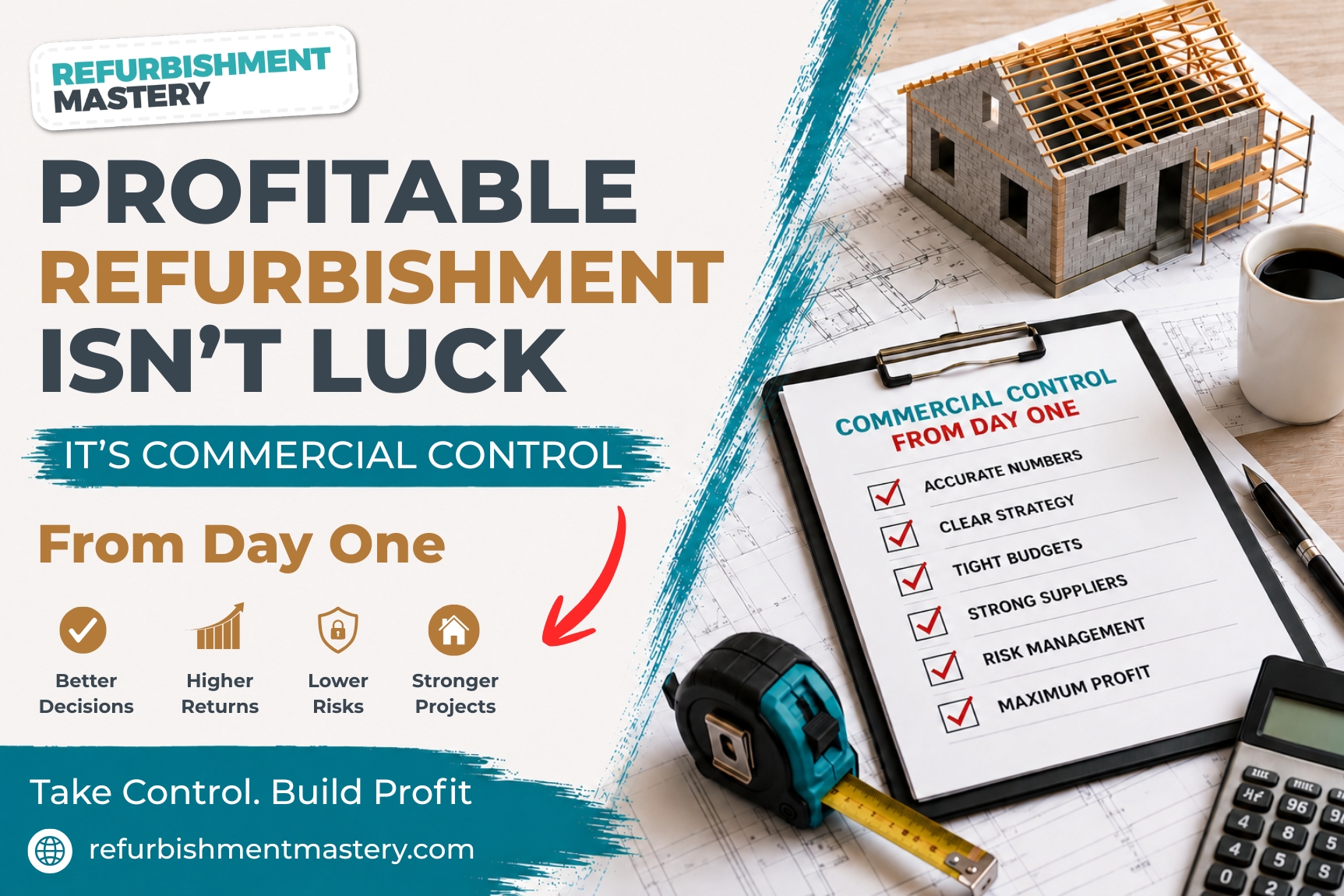
Profitable Refurbishment Isn't Luck — It's Commercial Control From Day One
If you are currently in the middle of a property refurbishment, or perhaps you are gearing up to start a new conversion fairly soon, you likely have a little voice in your head wondering exactly how it is all going to pan out. Will this project be a brilliant, profitable success, or will it turn into an expensive, stressful mess? It is entirely natural to hope for the best, perhaps looking for a few little gems of inspiration to make things run a bit smoother. But let's have a completely honest, friendly chat about what it actually takes to succeed in today's property market.
The Good Old Days Are Gone
Twenty years ago, property investing was considerably easier. Back then, estate agents weren't massively inflating the prices of properties that needed work, there was far less legislation to worry about, and there was usually enough profit sloshing around in a deal to cover up any amateur mistakes. If a problem unexpectedly popped up on site, you could simply throw a few thousand pounds at it, and the issue would quietly go away. You could, to a very large extent, simply wing your refurbishments.
Those days of easily winging it are well and truly over. Since the lockdowns of 2020 and 2021, the landscape has fundamentally shifted. We have seen the inflation of construction costs dramatically outstrip the end values of properties. On top of that, borrowing costs have significantly risen, stamp duty has increased, and we now face much more onerous building regulations covering environmental insulation and acoustics. We also have the new Building Safety Act—introduced largely following the Grenfell fire—which has added vital, yet costly, bureaucracy and safety compliances to our projects.
More Than Just Hiring a Builder
Because our profit margins are so much tighter now, relying on a casual handshake with a builder just doesn't cut it anymore. Excellent refurbishment project management requires understanding that a project is about far more than just the building work.
Consider a project I completed at the Victoria and Albert Museum in London. The task was to completely reconfigure their public toilets to include modern baby change and disabled facilities. This was a high-quality scheme costing tens of thousands of pounds, designed to perfectly match the prestige of the museum. Crucially, before the building contractor was even appointed, a massive amount of commercial planning had already taken place. An internal team had outlined the requirements, an architect had created the designs, various consultants had checked the heating and electrical loads, and a thorough tender pack was produced.
When the contractors finally arrived, strict refurbishment project management protocols were immediately enforced. The museum dictated that no noisy work could take place between 10:00 am and 8:00 pm, meaning trades had to start early or work late. Furthermore, material deliveries had to be booked 24 hours in advance, and driver registration details had to be provided to security beforehand. If the managers hadn't planned and joined up all these dots, the tradesmen wouldn't have been able to work at all, completely halting the project.
Taking Commercial Control on Your Projects
While you might not be working on a major London museum, the same principles of refurbishment project management apply to your own properties. To protect your profit and actively reduce your stress, you must operate like a professional.
This means taking absolute commercial control from day one:
Stop guessing: Unclear scopes of work and vague instructions to builders will cost you dearly. Builders today just want to get on with the job; if your instructions aren't totally clear, they will simply interpret them however they see fit, which leads to costly alterations later.
Build realistic budgets: You must dig incredibly deep during your planning phase to eliminate hidden costs, using a proper contingency fund only for genuine surprises, rather than relying on it to cover fundamental things you simply forgot to budget for initially.
Respect the timeline: You cannot expect to successfully tender a project and get a builder on site within a fortnight. Rushing the sequencing or being slow to make vital decisions costs your builder time, and ultimately, that lost time will cost you money.
Do You Need a Professional?
Refurbishment is not a roll of the dice. It only becomes risky when you charge in blindly, ignore your own weaknesses, and fail to put the right paperwork and the right people in place.
If you take the time to understand your management style and build a team that plugs your gaps, the process becomes enjoyable, far less stressful, and highly profitable. If you are serious about stepping up your game, consider looking into active property investment training to help you master these essential management skills. Stop relying on luck, and start managing your success.
