Refurbishment Management Tips to Reduce Project Risk
If you are anything like most property investors, you have probably felt that familiar knot of anxiety in your stomach before taking on a new project. You might be worried about paying too much for your next property, feeling anxious because you don't fully know how to handle the trades, or simply terrified that you'll be ripped off by a builder.
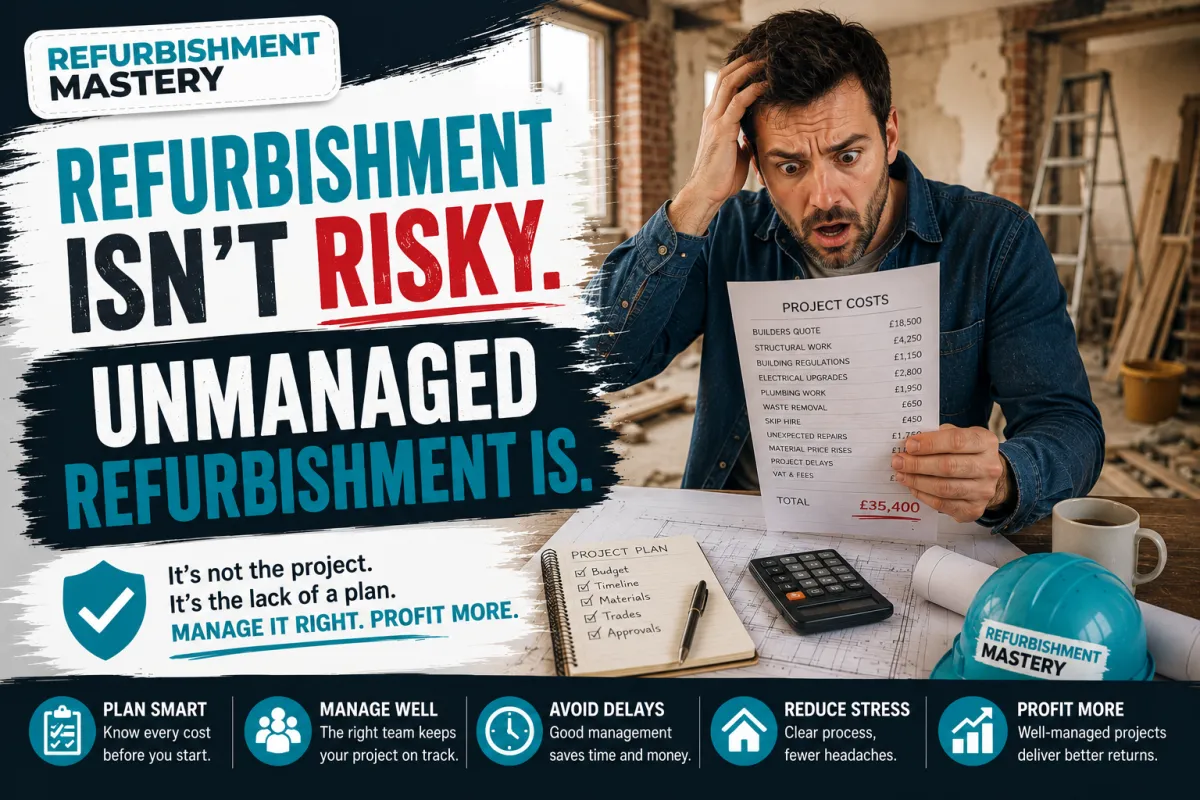
It is incredibly common to look at property refurbishment as a massive financial gamble. But any seasoned property refurbishment expert will tell you a very simple truth: refurbishment itself isn’t inherently risky. It is unmanaged refurbishment that causes all the headaches, drains your bank account, and keeps you awake at night.
The actual process of renovating a house is just a series of logical steps. The real risk lies in how you, personally, manage those steps.
Why We Get Management Wrong
Have you ever heard that famous quote, often credited to Albert Einstein, about the fish? It goes something like this: if you judge a fish by its ability to climb a tree, it will live its whole life believing that it is stupid.
The same logic applies to managing a property project. We all have completely different natural strengths and weaknesses. The traditional school system might have taught us to spend hours trying to fix our weak spots, but in business, you need to play directly to your natural strengths. The quickest way to ruin a project is to ignore how you naturally operate.
Signs Your Project is Poorly Managed
If you aren't playing to your strengths or putting the proper systems in place, things will quickly go south. Here are the classic red flags that a refurbishment is being managed poorly, which usually tie directly back to your natural personality profile.
Rushing in without a proper plan: Are you someone who gets incredibly excited about a new idea and just wants to crack on? This is a brilliant trait for finding deals, but a nightmare for management. A poorly managed project often starts without a detailed budget, lacks firm quotations from builders, and misses basic terms and conditions. Rushing can also lead to over-designing a property, giving it stunning features for a market that simply doesn't need them.
Failing to finish the job: Do you get easily bored halfway through a project? Another huge sign of bad management is running out of steam when it is time to complete the project. If a build drags on at the very end because nobody wants to tackle the fiddly tasks so tenants can actually move in, your management structure is failing.
Treating the trades like your best mates: Do you prefer chatting things through rather than writing them down? Managing your architect, quantity surveyor, and builders like they are your mates down the pub is a massive red flag. If you are avoiding paperwork, dodging spreadsheets, and relying entirely on verbal agreements, you are not managing the project-you are just hoping for the best.
Over-analysing every single detail: On the flip side, poor management can also look like complete operational paralysis. If you find yourself examining every nut, bolt, and penny while dreaming up worst-case scenarios, you might end up rejecting perfectly good, profitable deals.
How to Actually Manage a Refurbishment
So, how do you fix this and manage a project properly? Through active property investment training, you quickly learn a crucial lesson: you don't have to be brilliant at everything.
Good management starts with absolute self-awareness. You can actually take short assessments, like the Wealth Dynamics Test or the free Genius Test, to figure out your natural business profile in just a few minutes.
If you discover that you are a highly creative person who hates budgets, or a networking fanatic who despises paperwork, you shouldn't force yourself to be a detail-obsessed project manager. Instead, you manage the project by building a balanced team around you.
You need to bring in people who naturally love the things you hate. You want someone on your team who naturally follows processes, meticulously checks timelines, and gets genuine satisfaction from sweeping up loose ends. These grounded, detail-oriented people make natural project managers.
A true property refurbishment expert doesn't try to juggle every single ball. They understand their own blind spots and recruit accordingly. For example, if you need a property manager to look after day-to-day tenant issues on the ground, you should specifically look for someone who naturally thrives on following a task list right through to completion.
The Bottom Line
Refurbishment is not a roll of the dice. It only becomes risky when you charge in blindly, ignore your own weaknesses, and fail to put the right paperwork and the right people in place.
If you take the time to understand your management style and build a team that plugs your gaps, the process becomes enjoyable, far less stressful, and highly profitable. If you are serious about stepping up your game, consider looking into active property investment training to help you master these essential management skills. Stop relying on luck, and start managing your success.
