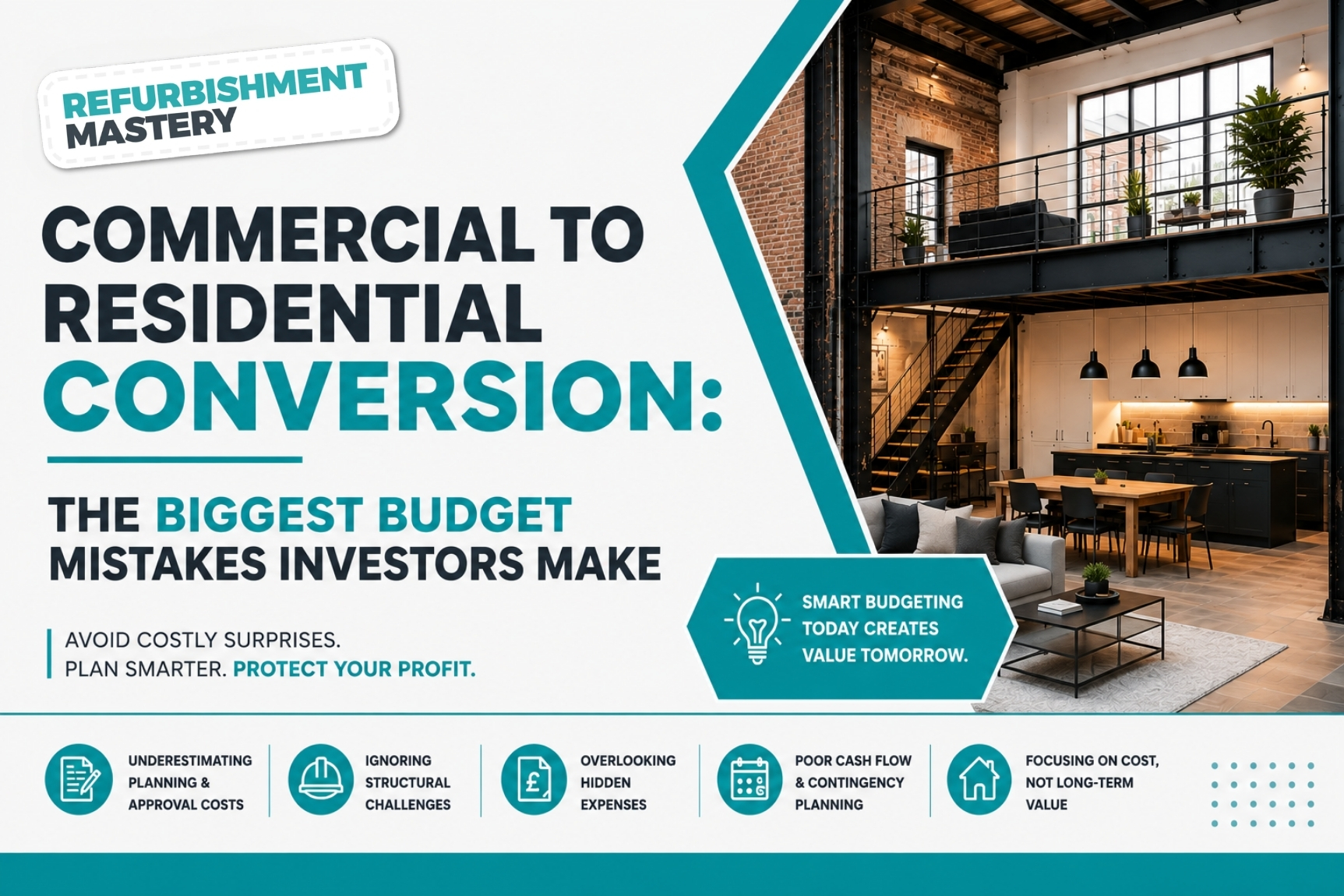
Commercial to Residential Conversion: Budget Mistakes
Transforming a redundant commercial building into a lucrative residential asset is the holy grail for modern property investors. However, without meticulous planning, commercial conversion costs can spiral completely out of control, eroding your profit margins before the first partition wall is even built. Whether you are tackling a high street retail unit or a large-scale office conversion, understanding exactly where the hidden financial pitfalls lie is paramount. In this comprehensive guide by Refurbishment Mastery, we explore the most severe budget mistakes investors make during a property conversion and how you can actively safeguard your capital.
Underestimating Unseen Commercial Conversion Costs
Many investors walk into a vacant building and only see the cosmetic potential. The harsh reality of a property conversion often lies hidden behind suspended ceiling tiles and beneath raised floors. Asbestos removal, upgrading insulation to meet stringent Building Regulations, and structural reinforcements are frequently overlooked during the initial viewing stage.
Failing to commission comprehensive surveys beforehand is a surefire way to inflate your commercial conversion costs. Before exchanging contracts, it is vital to consult with a structural engineer and obtain an asbestos survey. Skipping these due diligence steps to save a few hundred pounds will almost certainly cost you tens of thousands later down the line.
Planning Fallacies in an Office Conversion
While Permitted Development Rights (PDR) have made an office conversion far more accessible in the UK, it is certainly not a free pass. Investors mistakenly believe PDR means 'zero planning costs'. In reality, you still face Prior Approval fees, architects' and consultants' fees, and occasionally Community Infrastructure Levy (CIL) charges, depending on your local borough.
Furthermore, complying with Building Regulations for an office conversion is notoriously strict. You must account for acoustic testing (Part E), rigorous fire safety compliance (Part B), and thermal efficiency (Part L). Assuming a commercial building is ready for habitation just because the council granted PDR is a fast track to a blown budget. (For more details, property developers often consult planningportal.co.uk.)
The Utility Trap in a Property Conversion
Commercial buildings usually have a single incoming water, gas, and electric supply. Splitting these utilities to service multiple independent residential flats is astronomically expensive. Investors routinely under-budget for new statutory utility connections. Engaging with providers like UK Power Networks (UKPN) takes time and capital. Failing to apply for these new connections on day one can delay a property conversion by months, resulting in massive holding costs. You can read more about managing site logistics in the Refurbishment Mastery guide to project management
Skimping on Professional Education
One of the greatest budget mistakes is trying to learn on the job. The financial stakes in commercial developments are significantly higher than standard residential buy-to-lets. Enrolling in a comprehensive commercial-to-residential conversion course is an investment, not an expense. By thoroughly understanding the intricacies of the development process, you avoid costly rookie errors.
At Refurbishment Mastery, we have seen countless investors salvage failing projects simply because they finally sought expert mentorship. A robust commercial-to-residential conversion course teaches you how to accurately appraise a deal before committing your funds. If you do not know how to accurately calculate your Gross Development Value (GDV), a commercial-to-residential conversion course will give you the precise frameworks required to succeed.
Ignoring Finance and Holding Costs
Time is quite literally money in property development. A delayed office conversion means extended bridging loan interest, higher site insurance premiums, and standing council tax charges. Every single week your project overruns, your commercial conversion costs compound.
Always factor in a minimum 10% contingency fund and negotiate flexible finance terms. Make sure you fully understand your exit strategy, whether that is refinancing onto a commercial mortgage or selling the units on the open market.
Final Words
Executing a successful commercial project requires precision, patience, and professional knowledge. By anticipating hidden structural fees, respecting the nuances of the planning process, understanding utility separation, and investing in your own education, you can mitigate severe financial risks. Avoid letting unexpected commercial conversion costs ruin your deal. Instead, equip yourself with the right strategies to turn redundant spaces into highly profitable portfolios.
