




REFURBISHMENT
OFF THE GROUND
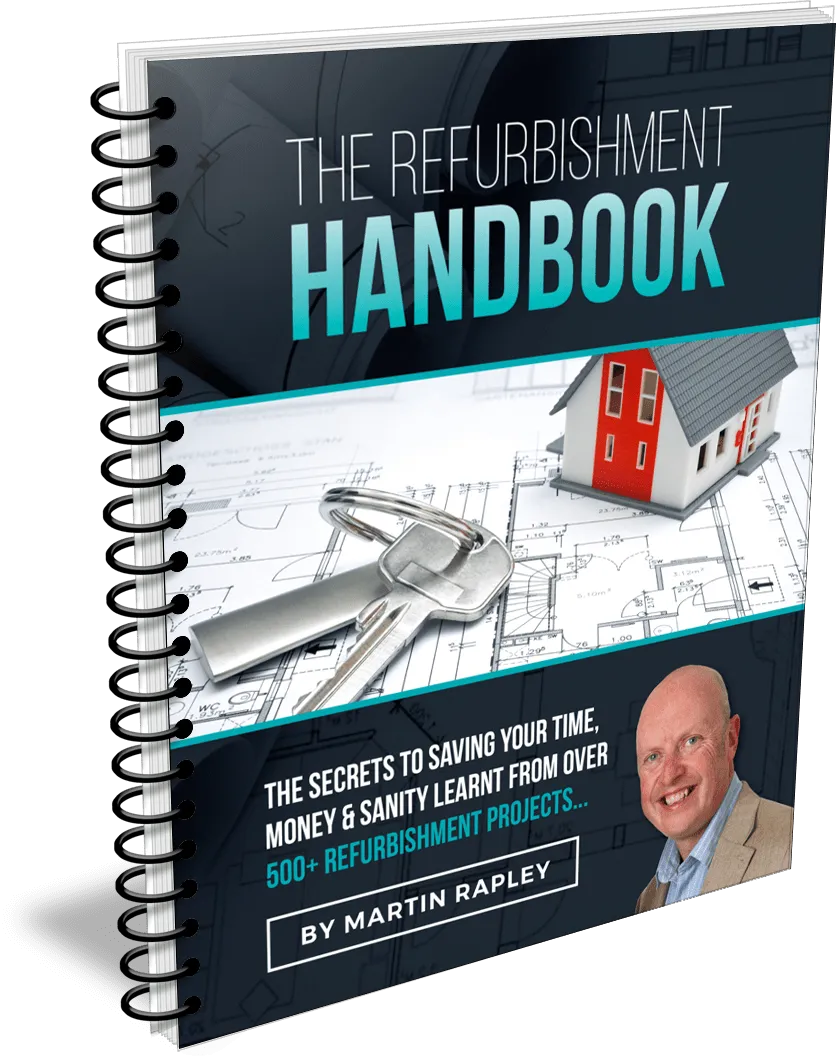
Property refurbishment can be highly stressful at times, often with the profitability of the whole deal hanging in the balance. With 1000+ refurbishments under his belt, Martin knows a thing or two about successfully running a project on time and to budget.
ADVANCED REFURBISHMENT
MASTERCLASS
Sunday 23 February 2020 • Heathrow, UK
Learn The Exact Steps To Carry Out Larger Refurbishments including HMOs, Flat Conversions and Commercial to Residential
Advanced Refurbishment Masterclass • 23rd February 2020 • Book Now >>
POPULAR VIDEOS FROM MARTIN




JOIN US ON SOCIAL MEDIA
WHAT OUR CUSTOMERS SAY
Mark Dearing
Kevin Cope
Martin Taylor
WANT IT ALL?
If you Don't want to wait to go through each of our products individually and want instant Life-time access to aLL of our training material, then this is for you. Your FAST route to becoming a refurb master!
- The Refurbishment Handbook You'll get a physical & digital copy of our market leading handbook.
- Refurbishment Quickstart Martin's hugely popular 4 part training series comes included.
- Refurbishment Masterclass This Online Training Course
-
Advanced Refurbishment Masterclass Course
-
ALL of our refurbishment templates and checklists
-
ALL of our factsheets for successful projects
-
Access to our video and training library
-
Updated regularly with brand new and exclusive content

How to spot a cowboy builder before they disappear with your deposit: a UK investor's due diligence checklist
June 23, 2026 • 3 min read
If you are a property investor worried about paying too much for your next property, concerned you do not know how to manage a project, or terrified of being ripped off by a builder, this is for you.
In this industry, we frequently hear horror stories about cowboy builders. But after 40 years of managing conversions and refurbishments, I can tell you a secret: there are fewer truly malicious builders out there than you think. Often, the disaster results from appointing the wrong type of builder or failing to conduct proper due diligence. Through the principles of Refurbishment Mastery, my goal is to give you the commercial edge to avoid these expensive traps.
Before spotting a cowboy, you need to understand who you are actually dealing with. I generally categorise builders into three types.
The tradesman who started a business. They are excellent at their craft but terrible at paperwork and cash flow, often finding their subcontractors at the local pub on a Friday afternoon.
The career-changer who is great at administration but lacks decades of hands-on site experience.
The management contractor is in my background. We manage the project professionally, handle the paperwork, and resolve site issues.
A cowboy often hides in that first group, not always out of malice, but because they are completely overwhelmed by the commercial reality of a complex conversion.
To protect your capital, you must look out for these critical red flags before you sign a contract.
Red Flag 1: The Scarcity Mindset and the "Cheapest Quote" Trap
If you approach contractors with a fundamentally flawed budget—say, expecting a £70000 conversion to be delivered for £50000—you instantly scare away the professional builders. The only people left willing to quote are the desperate ones who will inevitably cut corners. One of the biggest misconceptions I see is assuming the cheapest quote is a bargain. It is rarely a great deal. Often, the quote is low because vital elements are completely excluded, either by accident or intentionally. You think you have saved money, but halfway through the project, you are hit with massive variations. This is why undertaking comprehensive Property Project Management Training in the UK is essential; you must learn how to compare quotes like-for-like.
Red Flag 2: The Shiny Website and Meaningless Badges
Another massive misconception is that a polished website means a professional builder. Today, anyone can build a snazzy website. Are those photos really their projects, or are they stock images? Do not be fooled by marketing. Similarly, do not assume that an accreditation or an insurance policy guarantees peace of mind. Many accreditations are just a one-off box-ticking exercise, and the cheapest insurance policies often have exclusions that leave you carrying the financial risk if things go wrong. In our Property Project Management Training UK, we teach investors how to look past the marketing and audit a contractor's actual delivery capability.
Red Flag 3: The Big Upfront Deposit
This is perhaps the most dangerous red flag of all. It is a common myth that you must pay a massive upfront deposit to secure a builder. Once that money leaves your account, you lose all your commercial leverage. Are those funds actually buying materials for your conversion, or are they being used to cash-flow another investor's delayed project? Given that 3931 UK construction firms became insolvent in 2025, making up a staggering 17% of all business insolvencies, handing over unsecured cash is a catastrophic risk. If you want to protect your capital, a high-quality Property development project management course will teach you exactly how to implement valuation-based payments instead.
Red Flag 4: Blindly Trusting Recommendations
A recommendation from a friend gives us a false sense of security. But ask yourself: did your friend actually know what to check? Most people judge a builder based on whether they were friendly and if the job was eventually finished. That is not the same as delivering a commercially viable project on time and on budget. Furthermore, a builder who completed a simple cosmetic update might be entirely the wrong fit for your complex HMO conversion. No two projects are the same, which is a core lesson inside Refurbishment Mastery.
Red Flag 5: The "I'll Just Watch Them" Delusion
Many investors think they can hire a questionable builder and just keep them on track by visiting the site every day. This is a massive mistake. If you are on site every day answering questions, you are acting as a highly paid labourer, not a strategic manager. You end up firefighting and missing the wood for the trees.
Muddling your way through contractor selection will eventually cost you dearly. Do not hand over your control or your deposit based on hope. If you want to stop guessing and start running your projects like a professional, it is time to look into a dedicated Property development project management course. By adopting the commercial systems of Refurbishment Mastery, you can protect your profits, eliminate the cowboys, and get your projects delivered safely.
Dynamo: These are ideas, people. They are brilliant at starting projects but get bored easily, often rushing in without detailed budgets or proper contracts in place.
Blaze: Fantastic networkers who want to be mates with the builders. They prefer talking over compiling paperwork, which leaves them commercially exposed.
Tempo: Grounded, practical individuals who are great at following a structured task list right through to the end.
Steel: Highly analytical and detail-oriented. They thrive on complex spreadsheets, timelines, and commercial contracts. (This is my natural profile).
Natural refurbishment project management requires Tempo and Steel traits. If you are a Dynamo or a Blaze, you will naturally struggle with the essential paperwork and commercial rigour required to keep a site running without your daily presence.
When you combine a lack of natural management traits with a lack of planning, margins evaporate. A Houzz UK survey revealed that 50% of property refurbishers overshot their budgets, and according to the Q1 2026 RICS UK Construction Monitor, profit margin expectations across the industry have plunged to -27%. To avoid becoming a statistic, you must plug your natural gaps with a rigid, professional system.
The Secret to the 1-Day Week
To plug those natural gaps and implement professional systems, the secret is doing the unglamorous work upfront. At Refurbishment Mastery, we teach you to stop relying on generic templates and hope.
Instead of a basic summary, you need a "Schedule of Works." This document must be so meticulous, detailing exactly where every single socket and tile trim goes, that your builder can finish the conversion without asking you a thousand questions.
When you couple this detailed planning with Valuation-Based Payments, meaning you only pay the builder for work actually completed on site, you take back full commercial control. Your one day a week is then spent purely on a professional site visit to verify progress against the schedule, sign off on the valuation, and make clear strategic decisions.





Copyright © 2026 Priory Construction (Kent) Ltd All Rights Reserved •
Registered in England No. 07876799
Email: [email protected]
Office: Riverside House, River Lawn Road, Tonbridge, Kent, TN9 1EP
Terms & Conditions • Privacy Policy