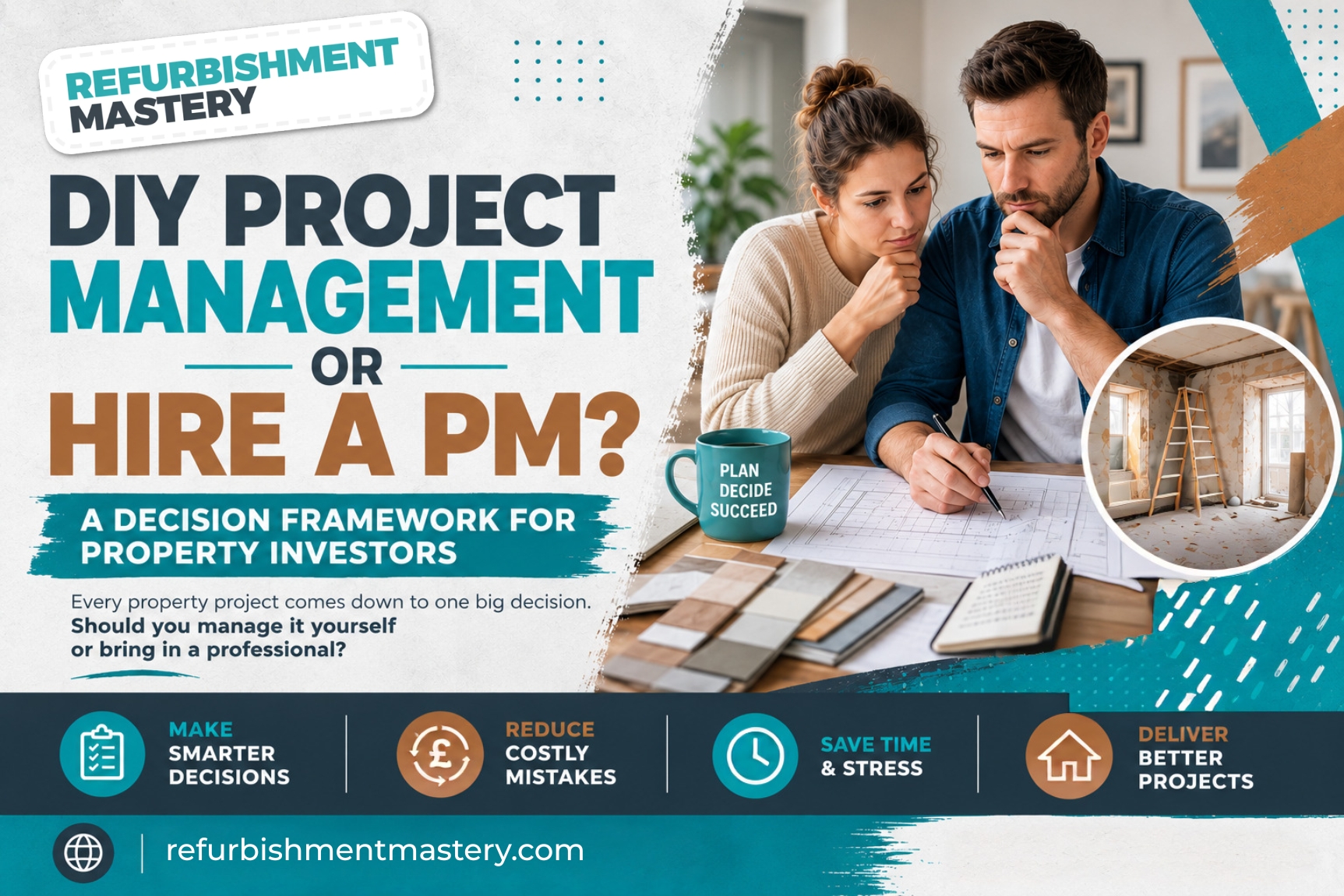
DIY or Hire a Project Manager? | Refurbishment Mastery
You have finally secured a promising property deal. The numbers look good on paper, and the potential uplift in value is clear. Now comes the biggest operational hurdle: how exactly are you going to manage the physical build?
Twenty years ago, you could largely wing a refurbishment. Back then, there was often enough profit sloshing around in a deal to easily absorb a few costly mistakes, and a quick handshake with a builder was usually enough to get the job done even without proper property refurbishment training. Today, the landscape is radically different. With tighter margins, rising costs, and the strict compliance introduced by the Building Safety Act, you must operate your site like a true professional.
This leaves every property investor with a critical commercial decision: do you manage the project yourself, or do you hire a professional project manager?
What does Hiring a Professional Mean?
Let’s start by looking closely at the numbers. Hiring a high-quality, independent project manager is a significant capital investment. Even for the most straightforward projects, you can expect to pay around £8,000 in management fees. If you are taking on a more complex HMO conversion, those fees typically range from £12,000 to £15,000. For larger, commercial-to-residential developments, a project manager's fee can easily exceed £20,000.
For an investor managing a smaller scheme, that £8,000 fee might completely wipe out your profit margin. However, a professional project manager delivers absolute commercial control. Think of a project manager as the central axle of a bicycle wheel, bringing together all the separate spokes—the architects, structural engineers, surveyors, and tradespeople. They draft early risk assessments, independently push consultants to meet vital deadlines, and run the site so smoothly that you are completely shielded from the daily noise and chaos.These responsibilities become even more important on larger developments, where systemised project management can make the difference between a controlled refurbishment and a chaotic one.
When to DIY Your Project Management
A massive mistake many DIY investors make is assuming they can simply let their main builder act as the project manager. Builders are skilled in construction, but investors who lack property refurbishment training often underestimate the importance of project planning, commercial strategy, and consultant coordination.
To successfully manage your own site, you need to be honest about your natural operational strengths and understand what it takes to become a better property project manager. According to the Genius business profiling system, if you are a 'Tempo' or 'Steel' profile, you are naturally grounded, detail-oriented, and process-driven. Because you genuinely enjoy spreadsheets, tight timelines, and tying up loose ends, you will likely thrive as your own project manager. By taking the time to undergo proper property refurbishment training, you can easily layer the necessary technical construction knowledge over your natural organisational skills.
When You Absolutely Need Help
On the other hand, what if you are a 'Dynamo' or a 'Blaze' profile? You are likely a fantastic networker and a brilliant big-picture thinker, but you probably despise spreadsheets, avoid paperwork, and get bored easily halfway through a build.
If you DIY the management without adapting, you risk managing tradesmen through informal chats rather than strict written contracts, leading directly to misunderstandings and spiralling costs. Furthermore, when unexpected site problems arise, an unmanaged builder naturally suggests the quickest, cheapest fix. This becomes particularly important on larger conversions, where a structured commercial conversion project management process is essential for coordinating consultants, compliance and construction. An educated investor, however, learns to evaluate these problems holistically, enforcing long-term solutions that protect the asset for the next 20 or 30 years.
If you know you lack a detail-oriented focus, or if you are stepping up to a massive commercial project with high financial risks, mastering these project management skills yourself—rather than outsourcing them for a £15,000 or £20,000 fee—is the smartest way to protect your overarching investment.
The Third Option: Supported DIY Management
For many ambitious investors, there is a highly profitable middle ground. You do not have to blindly guess your way through a project, but you also do not have to hand over £8,000 for full project management.
Instead, you can choose to become an expert client. By engaging in comprehensive property refurbishment training, you can learn the exact blueprints, risk assessments, and contractual frameworks that the professionals use. The Refurbishment Mastery approach is all about gaining the knowledge to make the right decisions at the right time, effectively acting as your own project manager with an expert holding your hand in the background.
The greatest benefit of this middle path is the compounding value. Once you master the systems on your first project, you retain that knowledge forever, saving yourself an £8,000+ fee on every single subsequent deal you do.
Ultimately, the decision to DIY or hire a project manager comes down to your budget, the scale of your development, and your own personality. Whichever route you choose, remember that profitable refurbishment relies on deliberate, meticulous management from day one.
